Current and Charge
Table of Contents
1. Charge
The most fundamental unit of circuits is charge, which consists of either negativley charged electrons or positively charged protons. Charge has the following four fundamental properties:
- Charge can either be positive (\(e^+\)) or negative (\(e^-\)).
- The fundamental (smallest) quantity fo charge is that of a signle electron or proton.
- The law of conservation of charge states that the net charge in a closed region can neither be created nor destroyed.
- Two like charges repel, whereas two opposite charges attract.
The unit of charge is the coulomb and the magnitude of \(e\), the fundamental unit of charge is:
\begin{align} e = 1.6 \times 10^{-19} \text{ C} \end{align}2. Current
The movement of charge gives rise to current, which is defined as the time rate of transfer of electric charge across a specified cross section. In other words:
\begin{align} i = \frac{\text{d}q}{\text{d}t} \end{align}By convention, the flow of current is defined to be from the positive terminal to the negative terminal:
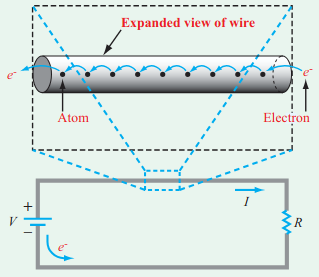
Current is caused by the flow of electrons. However, individual electrons move slowly through the wire with what is called the drift velocity at approximately \(0.1 \frac{\text{mm}}{\text{s}}\). Information flows very fast though, with what is called the transmission velocity at approximately \(0.6-0.9 c\), where \(c\) is the speed of light. °
We can compute charge from a current graph by taking the integral, since \(\text{d}q = i\text{ d}t\):
\begin{align} Q = \int_{t_0}^{t_1} i(t) \text{ d}t \end{align}