Inductors
Table of Contents
1. Inductors
In its simplest form, an inductor is a coil of wire with current flowing through it:
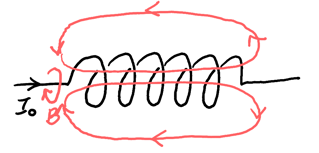
The energy of an inductor is stored in the magnetic field around the inductor. It is governed by Faraday’s Law of Induction, which says that a time varying magnetic flux induces a voltage across the coil which is propotional to the rate of change in the current. This proportionality constant is known as inductance:
\begin{align} \boxed{v(t) = L\frac{\text{d}i}{\text{d}t}} \end{align}Then, the current through the inductor is:
\begin{align} \boxed{i(t) = \frac{1}{L}\int_{t_0}^t v(t)\text{ d}t + i(t_0)} \end{align}1.1. Energy Storage
We know that power is:
\begin{align} p(t) &= i(t)v(t) \notag \\ p(t) &= i(t)L\frac{\text{d}i}{\text{d}t} \notag \\ \int p(t) \text{ d}t &= \int i(t)L\text{ d}i \notag \\ W &= \int Li\text{ d}i \notag \end{align}Thus, the energy stored in a charged inductor is:
\begin{align} \boxed{W = \frac{1}{2}Li^2} \end{align}1.2. Inductors in Series
Inductors in series share a common current:
Then, we have:
\begin{align} V_L = V_1 + V_2 = L_{\text{eq}}\frac{\text{d}i}{\text{d}t} \notag \end{align}Substituting, we get:
\begin{align} L_1\frac{\text{d}i}{\text{d}t} + L_2\frac{\text{d}i}{\text{d}t} &= L_{\text{eq}}\frac{\text{d}i}{\text{d}t} \notag \\ \Rightarrow L_{\text{eq}} &= L_1 + L_2 \notag \end{align}Thus, it follows that for inductors in series, we have:
\begin{align} \boxed{L_{\text{eq}} = \sum_{i=1}^n L_i} \end{align}1.3. Inductors in Parallel
Inductors in parallel share a common voltage:
We know that:
\begin{align} V = L_1 \frac{\text{d}i_1}{\text{d}t} &\Rightarrow \frac{V}{L_1} = \frac{\text{d}i_1}{\text{d}t} \notag \\ V = L_2 \frac{\text{d}i_2}{\text{d}t} &\Rightarrow \frac{V}{L_2} = \frac{\text{d}i_2}{\text{d}t} \notag \\ V = L_{\text{eq}} \frac{\text{d}i}{\text{d}t} &\Rightarrow \frac{V}{L_{\text{eq}}} = \frac{\text{d}i}{\text{d}t} \end{align}Then, since \(i=i_1+i_2\),
\begin{align} \frac{V}{L_{\text{eq}}} &= \frac{\text{d}}{\text{d}t}(i_1+i_2) \notag \\ \frac{V}{L_{\text{eq}}} &= \frac{\text{d}i_1}{\text{d}t} + \frac{\text{d}i_2}{\text{d}t} \notag \\ \frac{V}{L_{\text{eq}}} &= \frac{V}{L_1} + \frac{V}{L_2} \notag \\ \frac{1}{L_{\text{Eq}}} &= \frac{1}{L_1} + \frac{1}{L_2} \notag \end{align}Thus, it follows that for inductors in parallel:
\begin{align} \boxed{\frac{1}{L_{\text{eq}}} = \sum_{i=1}^n \frac{1}{L_n}} \end{align}1.4. Mutual Inductance
Mutual inductance occurs when two windings are arranged so they have mutual flux linkage — two inductors are close enough such that flux from one inductor can go through the other. Then, a change in current in one winding causes a voltage to be induced in the other:
This is the basis of how transformers work.