Friction
Table of Contents
1. Friction
Consider a block on a rough surface and a force \(\mathbf{P}\) applied to it. We can make several observations:
- if the \(P\) is small enough, the block will not move
- at some critical value \(P = P^*\), motion is initiated
- once the block starts moving, a constant force \(P^{**} < P^*\) is required to move it at a constant speed
- if the mass of the block increases, \(P^*\) and \(P^{**}\) increases
Friction results from two objects rubbing against each other, with the general direction parallel to the surface of contact between the two objects. Say point \(P\) on the block touches point \(Q\) on the surface. Call \(v_{\text{rel}} = v_p-v_q\). Using our observations, we can define two types of friction: static friction and kinetic friction.
It takes a larger amount of force to first overcome static friction than to keep the block moving past kinetic friction.
1.1. Kinetic Friction
Kinetic friction occurs when \(v_{\text{rel}} \neq 0\):
\begin{align} \boxed{f_k = \mu_k F_N} \end{align}where \(\mu_k\) is the coefficient of kinetic friction.
Example: Block sliding down ramp
Consider a block sliding down a ramp (from rest), with friction:
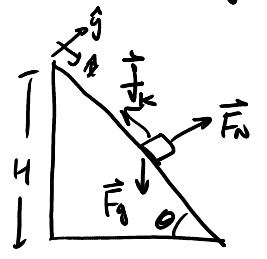
Determine the unknowns, \(\vec{a}\) and \(F_N\), if we are given \(\mu_k\). We have the following two equations:
\begin{align} mg\sin\theta - f_k &= ma \notag \\ F_N&= mg\cos\theta \notag \end{align}Simplifying, we have:
\begin{align} mg\sin\theta - \mu_kF_N &= ma \notag \\ \sin\theta - \mu_k\cos\theta &= a \notag \\ a &= g\sin\theta - \mu_kg\cos\theta \notag \\ a &= g(\sin\theta - \mu_k \cos\theta) \notag \end{align}Example: Two blocks and pulley
Consider two blocks connected with an ideal string like so:
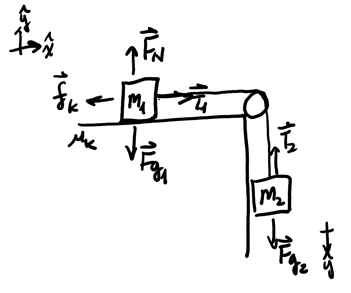
We want to find the tension force in the rope and the acceleration of the blocks. For the first block in the y-direction, we have:
\begin{align} F_N = m_1g \notag \end{align}For the first block in the x-direction and the second block in the y-direction, we have:
\begin{align} T_1 - \mu_kF_N &= m_1a_1 \notag \\ m_2g - T_2 &= m_2a_2 \notag \end{align}Since this is an ideal rope, we know that \(T=T_1=T_2\) and \(a=a_1=a_2\), thus:
\begin{align} T - \mu_kF_N &= m_1a \notag \\ m_2g - T &= m_2a \notag \end{align}Combining and substituting our value for \(F_N\), we can find the acceleration of both blocks:
\begin{align} m_2g - \mu_kF_N &= (m_1+m_2)a \notag \\ a &= \frac{m_2 - \mu_km_1}{m_1 + m_2} g \notag \end{align}We can now solve for tension:
\begin{align} m_2g - T &= \frac{m_2 - \mu_km_1}{m_1 + m_2} m_2g \notag \\ T &= (1 - \frac{m_2-\mu_km_1}{m_1+m_2})m_2g \notag \\ T &= \frac{m_1m_2 (1+\mu_k)}{m_1 + m_2} g \notag \end{align}1.2. Static Friction
Static friction occurs when \(v_{\text{rel}}=0\). It increases relative to how much force is applied to the object, and therefore it is an inequality:
\begin{align} \boxed{f_s \leq \mu_s F_N} \end{align}where \(\mu_s\) is the coefficient of static friction. Static friction reaches its maximum (before allowing the object to move) at \(f_{s_\text{max}}=\mu_s F_N\).
Example: Block on ramp
Consider a block on a ramp with angle \(\theta\):
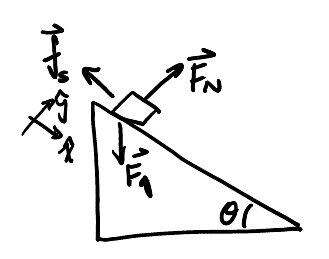
Determine the maximum angle of the ramp, \(\theta_\text{max}\), to ensure that the block remains stationary.
Since the block would be moving down and to the right, the direction of friction will oppose this motion by going up and to the left.
Through Newton’s second law, we can write the following equations:
\begin{align} mg\sin\theta_\text{max} - f_{s_\text{max}} &= 0 \notag \\ F_N &= mg\cos\theta_\text{max} \notag \end{align}Consider that \(\theta\) reaches \(\theta_\text{max}\) when \(f_s=f_{s_\text{max}}=\mu_sF_N\). Thus,
\begin{align} mg\sin\theta_\text{max} - \mu_s F_N &= 0 \notag \\ \sin{\theta_\text{max}} - \mu_s\cos\theta_\text{max} &= 0 \notag \\ \tan\theta_\text{max} &= \mu_s \notag \\ \theta_\text{max} &= \tan^{-1}(\mu_s) \notag \end{align}